Business
Uganda Woos Dangote for $Billion Oil Refinery, Fertiliser and Salt Projects

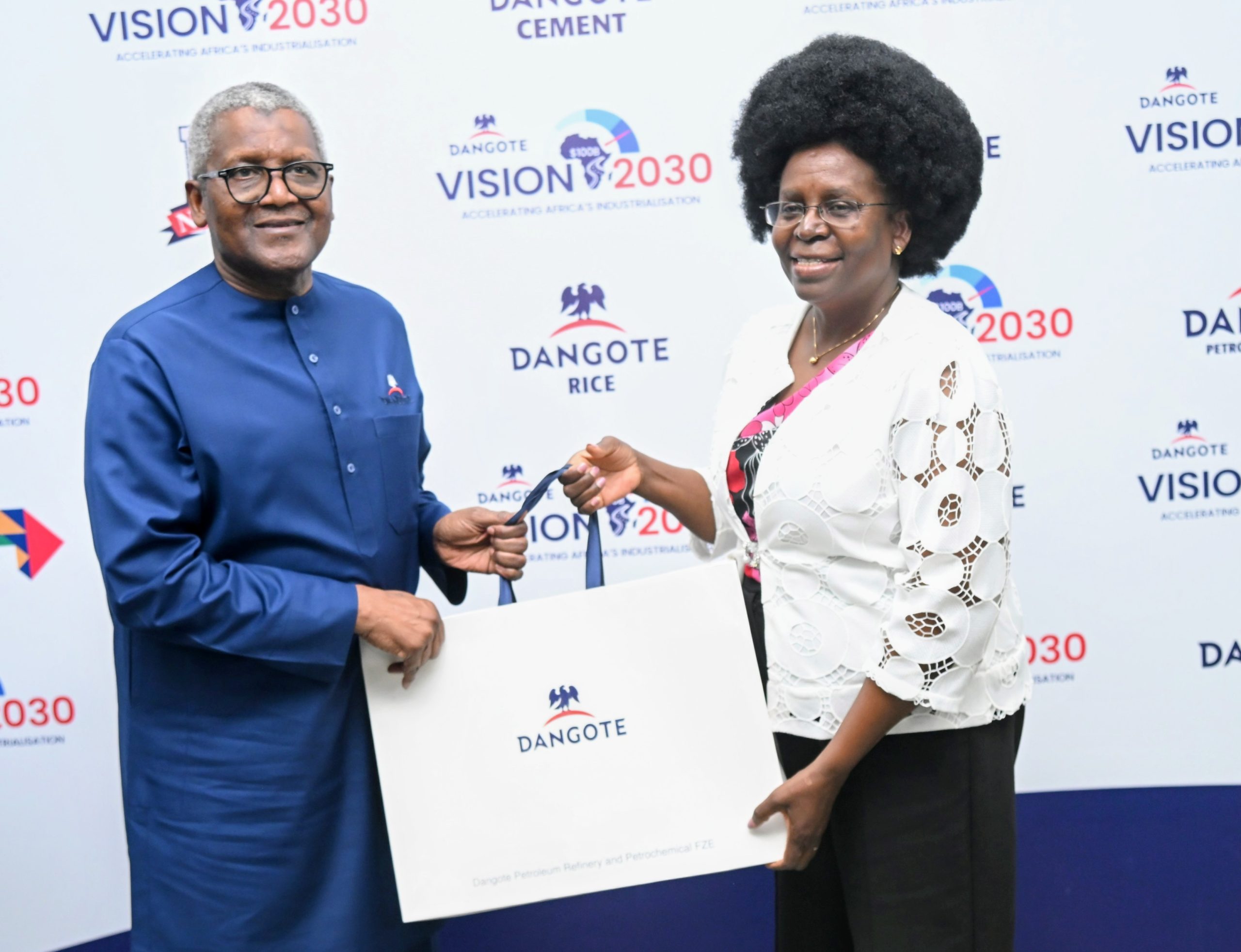
East African nation seeks Nigerian billionaire’s investment to transform crude oil and mineral resources into finished products, create jobs and boost industrialisation.
The Ugandan Government has approached Nigerian industrialist Aliko Dangote to invest in its proposed multi-billion-dollar oil refinery project, as well as fertiliser and salt production, in a move aimed at accelerating industrialisation and reducing dependence on imported finished products.

The investment proposal was presented during a visit by a Ugandan government delegation to the Dangote Petroleum Refinery and Petrochemicals and Dangote Fertiliser Limited facilities in Lagos.
The delegation was led by Uganda’s Minister of Energy and Mineral Development, Dr Monica Musenero Masanza, and Minister of State for Finance, Planning and Economic Development (Privatisation and Investment), Hajjat Amina Mukalazi.
The ministers expressed their government’s readiness to support the proposed partnership, noting that Uganda was seeking to leverage Dangote Group’s industrial expertise to convert its natural resources into finished products, generate employment and strengthen its economy.
President and Chief Executive of Dangote Industries Limited, Aliko Dangote, received the delegation alongside senior executives of the conglomerate, including Group Vice-President, Devakumar Edwin; Group Executive Director, Logistics and Distribution, Abdu Dantata; Group Executive Director, Commercial Operations, Oil and Gas, Fertiliser, Fatima Aliko Dangote; and Managing Director, Infrastructure and Logistics, Captain Jamil Mohammed Abubakar.
Presenting Uganda’s investment proposals, Mukalazi invited Dangote Group to take a leading role in the country’s proposed 60,000-barrel-per-day oil refinery project in the Hoima area.
She described the refinery as a major industrial priority for Uganda, adding that the project would benefit from Dangote Group’s experience in engineering, construction and the operation of large-scale industrial facilities.
“You have shown that an African company can build world-scale industry in Africa and run it by Africans themselves,” Mukalazi said.
She noted that the proposed refinery could complement Dangote Group’s planned refinery investment in Lamu, Kenya, with the Ugandan facility serving inland markets while the Kenyan project caters to coastal and maritime markets.
Beyond oil refining, the Ugandan delegation also identified investment opportunities in fertiliser blending, phosphate processing and salt manufacturing, describing them as interconnected industries that could benefit from shared infrastructure and distribution networks.
“Our crude, our phosphate, our salt are waiting to be turned into fuel, fertilisers and chemicals here in Africa and in Uganda by Africans,” Mukalazi stated.
The minister also invited Dangote to visit Uganda for further discussions, assuring him that the government would address potential investment challenges and create an enabling environment for the proposed projects.
“Uganda needs Dangote, and now is the right time. Our country is ready and moving rapidly towards industrialisation,” she said.
Mukalazi added that the proposed investment would extend beyond capital injection to include technology transfer, skills development, employment generation and opportunities for local businesses.
“As the minister responsible for investment, I want to assure Alhaji Dangote that the government will support his investment and work to remove bottlenecks,” she added.
She particularly highlighted the potential employment opportunities for young Ugandans through the establishment of large-scale manufacturing facilities.
Also speaking, Uganda’s Minister of Energy and Mineral Development, Dr Monica Musenero Masanza, said the delegation visited Nigeria to understudy Dangote Group’s industrial operations and explore practical areas of collaboration in petroleum refining and fertiliser manufacturing.
She explained that Uganda possessed mineral resources suitable for fertiliser production but had faced challenges converting them into finished products.
“We also have minerals that can be used to produce fertilisers, but our efforts to convert those resources into fertilisers have not been very successful. Here, we have seen a very large fertiliser manufacturing facility,” she said.
Musenero described the proposed collaboration as an opportunity for African countries to leverage their respective strengths and develop industrial capacity within the continent.
“This is setting a new standard for African thinking and for what we believe we can achieve. Sometimes, we think too small,” she said.
She expressed optimism about the proposed partnership, adding that Uganda wanted an early follow-up visit to advance discussions on the investment opportunities.
Meanwhile, Managing Director and Chief Executive Officer of Dangote Petroleum Refinery and Petrochemicals, David Bird, said the presence of two Ugandan ministers demonstrated the country’s commitment to exploring an industrial partnership with the Dangote Group.
Bird described Uganda as a country with significant natural resources and human capital, noting that the government had demonstrated the ambition and political will required to drive industrial development.
“Uganda has incredible natural resources and human capital. As both ministers have expressed during this visit, there is also no shortage of ambition or political will to pursue industrialisation,” he said.
He explained that the engagement provided an opportunity for both parties to identify common interests, explore investment opportunities and strengthen the group’s expansion plans across East Africa.
“The visit demonstrates the strength of the relationship and the importance attached to identifying common ground, exploring opportunities and strengthening our expansion into East Africa as part of Vision 2030,” Bird added.
The proposed Ugandan investments align with Dangote Group’s broader Vision 2030 strategy to expand its industrial footprint across Africa through strategic investments in manufacturing, energy, petrochemicals and other critical sectors.
If realised, the proposed partnership could strengthen economic cooperation between Nigeria and Uganda while creating opportunities for technology transfer, local manufacturing, employment and regional trade.
However, the proposed projects remain subject to further discussions and technical assessments between the Ugandan Government and Dangote Group.





Uganda Woos Dangote for $Billion Oil Refinery, Fertiliser and Salt Projects

Dangote Sinotruk Unveils Nigeria’s First Locally Assembled Electric Heavy-Duty Truck

Atiku Tackles Tinubu Over Plateau Apology, Says Residents Needed Him During Attacks

Kogi Police Dismiss Political Motive Allegation Over Vigilantes’ Firearms Training

SunTrust Bank boosts staff welfare, raises salaries up to 75%, promotes 25% of workforce

Dangote Plans 10,000MW Power Investment, Raises Africa Investment Target to $70bn

Flamingos Receive $50,000 Reward After Historic U-17 Women’s World Cup Victory

Manchester United Rescue Dramatic 4-4 Draw Against Aston Villa in Eight-Goal Thriller

Open A FirstBank Account Digitally, Anytime, Anywhere

Fidelity Bank, NCF Deepen Environmental Sustainability Partnership at 20th Walk for Nature

Paraguay Impeaches President Santiago Peña, Places Him Under Arrest Over Banking Crisis

Jorge Jesus, Nani Pay Tribute To Ronaldo Following Portugal Retirement

Wema Bank Unveils 21 Finalists for Hackaholics 7.0 Grand Finale in Lagos

Namibia President Declares Dangote’s $2.5bn Energy Investment a Landmark for Africa’s Industrial Future

Peller Regrets Crashing Car For Jarvis, Accuses Wife Of Calling Him Manipulator